.png)
Why Footwork Is a Key Part of Every Reformer Class and Its Benefits
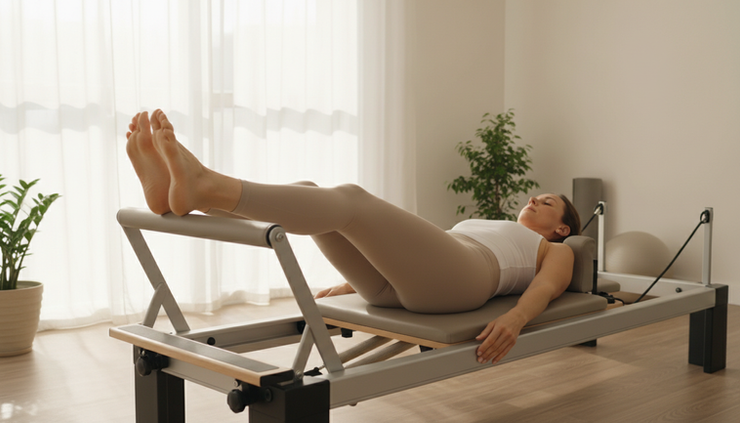
Footwork can look like the “simple” part of a reformer class. You lie down, place your feet on the bar, press the carriage out, and return. Then you do it again. And again.
Yet a good instructor keeps coming back to it for a reason.
Footwork is one of the clearest ways to prepare the body, read alignment, build strength, and teach control before the class moves into more complex exercises. It connects the feet, legs, pelvis, spine, and breath in one organised movement. That makes it far more than a warm-up.
In many reformer classes, footwork is the first place where the body starts to understand the session ahead. It wakes up the lower body, introduces the spring tension, and gives the nervous system time to settle into the rhythm of the machine. It also gives the instructor useful information, including how the ankles move, whether the knees track well, and how evenly both sides of the body are working.
This post explains why footwork appears in almost every reformer class, what it does for the body, and how small changes in foot position can create big benefits.
This article is for general information only and does not replace advice from a qualified health professional or a trained Pilates instructor who can assess individual needs.
Footwork prepares the whole body, not just the feet
The name can be misleading. Reformer footwork starts at the feet, but it does not stay there.
When the feet press into the bar, the force travels through the ankles, knees, hips, pelvis, and spine. The springs create resistance, so the body has to organise itself to move the carriage smoothly. This is why instructors often cue the exercise with details like:
Press through the whole foot
Keep the knees tracking over the toes
Lengthen the back of the neck
Let the ribs stay heavy
Control the carriage on the way home
These cues are not just about form. They teach the body how to move with more support.
In everyday life, the feet are the first point of contact with the ground whenever we stand, walk, climb stairs, or run. If the feet collapse, grip, roll out, or avoid weight evenly, the rest of the body often compensates. The knees may turn in. The hips may tighten. The lower back may overwork.
Reformer footwork gives all of this a closed, supported place to improve. Because the body is lying down, there is less demand from gravity than there would be in a standing squat or lunge. That allows more focus on detail.
The body can practice:
Even pressure through the feet
Smooth bending and straightening of the knees
Balanced effort between both legs
Steady pelvic placement
Gentle core support
Controlled breathing
That is why footwork is often used at the start of class. It is a way of checking in. It helps the body move from the outside world into the work of the session.
A rushed body becomes a more focused body. A stiff body begins to warm. A disconnected body starts to feel where it is in space.
That is the first benefit of footwork. It creates readiness.
The springs teach control from the first few minutes
The reformer is not a passive machine. The springs respond to the way the body moves.
If someone pushes out quickly and lets the carriage crash back in, the springs make that obvious. If one leg works harder than the other, the carriage may shift or feel uneven. If the feet lose contact with the bar, the movement feels less stable.
Footwork teaches control in both directions:
Pressing out
Returning in
The legs strengthen as they move against spring resistance.
The body learns to control the springs instead of being pulled by them.
This second part matters. Many people focus on the push, but the return builds just as much awareness. The muscles have to stay active while lengthening and controlling the carriage. That kind of control helps with balance, joint support, and smoother movement patterns.
In a strong class, footwork is not treated as a throwaway warm-up. It is where the quality of movement begins.
Footwork builds strength in the legs, hips, and center
Reformer footwork is one of the most reliable ways to build lower-body strength without needing impact. The springs add resistance, while the carriage supports the body. This combination makes the exercise useful for a wide range of levels, from beginners to experienced clients.
The main muscles involved include:
Calves
Quadriceps
Hamstrings
Glutes
Deep hip stabilisers
Abdominals
Pelvic floor muscles, when engaged appropriately
Muscles around the feet and ankles
The legs do the visible movement, but the centre of the body has to organise the work. If the pelvis rocks, the ribs flare, or the lower back arches strongly, the body loses some of that organisation. A good instructor will use footwork to help the body find a steadier position.
This is one reason footwork appears in almost every reformer class. It strengthens the lower body while also teaching the spine and pelvis to stay connected.
The movement may look simple, but the body is doing several things at once:
Pushing against resistance
Keeping the knees aligned
Maintaining even weight through both feet
Controlling the pelvis
Breathing steadily
Returning the carriage with precision
That is a lot of coordination.
And because the movement can be repeated with different foot positions, it can target the legs in slightly different ways without needing to change the whole exercise.
Different foot positions create different benefits
In many classes, footwork includes several variations. Each one teaches something useful.
Heels on the bar
This foot position often helps people feel the back of the legs and the connection into the hips. It can encourage better awareness of the hamstrings and glutes. It also gives a clear sense of pressing through the center of the heel, which can help with stable leg alignment.
Toes or arches on the bar
This position asks more from the ankles, calves, and feet. It can help build strength through the lower leg and improve awareness of how the foot wraps around support. The body also learns to keep the ankles steady instead of letting them wobble or collapse.
Pilates V
With the heels together and toes slightly apart, the hips externally rotate. This position can help connect the inner thighs and deep hip muscles. It also teaches the legs to move with control without letting the knees drift too wide or collapse inwards.
Parallel stance
Parallel footwork is one of the most practical positions because it reflects many real-life movements. Walking, standing, squatting, and climbing stairs all ask the legs to organise in a parallel pattern. Practising it on the reformer can help improve awareness in daily movement.
Single-leg footwork
Single-leg variations reveal imbalance quickly. One side may feel stronger, more stable, more coordinated, or more mobile than the other. That information is useful. It allows the class to build more balanced strength rather than letting the dominant side do all the work.
Footwork can be gentle, strong, precise, or challenging depending on the springs, foot position, tempo, and range of movement. That flexibility makes it valuable in almost every class.
Footwork improves alignment and joint awareness
One of the biggest benefits of reformer footwork is the way it teaches alignment without making the body feel forced.
In standing exercises, it can be hard to notice where the knees, hips, feet, and pelvis are moving. The body is busy balancing. On the reformer, the support of the carriage gives more room to feel the details.
A skilled instructor may watch for:
Knees rolling inward
Knees drifting outward
Ankles collapsing
Toes gripping
Uneven pressure between the left and right foot
Pelvis shifting from side to side
Lower back over-arching
Ribs lifting away from the carriage
Carriage movement that feels jerky or uneven
None of these things mean someone is doing badly. They are useful clues. Footwork makes them visible, then gives the body a chance to practise a clearer pathway.
The aim is not rigid perfection. Bodies vary, and alignment should suit the person in front of the instructor. The real goal is efficient movement, where the joints are supported and the effort is well distributed.
The knees learn to track with more support
Knee tracking is one of the most common reasons instructors pay close attention during footwork. When the knees bend and straighten, they ideally follow the general line of the toes rather than dropping in or pushing far out.
This matters because the knee sits between the foot and the hip. If the foot is unstable or the hip lacks control, the knee often shows the result. Footwork gives the instructor a simple way to help the whole chain work together.
A common cue is to imagine the thigh bones sliding straight out from the hips. Another is to press evenly through the big toe mound, little toe mound, and heel. These cues help the feet and hips share responsibility, rather than leaving the knees to manage everything alone.
Over time, this can support better movement in other exercises, such as bridges, lunges, scooter, side splits, chair work, and standing balance work.
The ankles and feet become more responsive
Many people only notice their feet when something hurts. Reformer footwork brings the feet back into the conversation before there is a problem.
The feet contain many joints and muscles. They are designed to move, adapt, and give feedback to the brain. When they spend most of the day in stiff shoes or on flat surfaces, they can lose some of that responsiveness.
Footwork asks the feet to sense pressure and adjust. The toes may spread. The arches may lift slightly. The ankles may find a steadier path. The calves may work with better timing.
This can improve proprioception, which is the body’s awareness of position and movement. Better proprioception can make movement feel more coordinated and grounded.
That is why even small details, such as whether the toes are gripping or relaxed, matter. They change how the body receives information.

Footwork supports mobility, circulation, and movement confidence
Footwork is not only about strength. It also helps the body move more freely.
The repeated bending and straightening of the legs encourages movement through the ankles, knees, and hips. Calf raises, prances, and tendon stretch variations add more work through the feet and ankles. These small sequences can feel simple at first, but they often reveal stiffness that affects the rest of the body.
For example, limited ankle movement can change how someone squats, walks, climbs stairs, or balances. If the ankle cannot move well, the body may borrow movement from the knees, hips, or lower back. Reformer footwork gives the ankle a supported way to practise range and control.
The calf pump helps the body feel awake
When the ankles point and flex, the calf muscles contract and release. This action supports normal blood flow back towards the heart. It is one reason the lower legs can feel more awake after prances or calf work on the reformer.
This does not mean footwork is a medical treatment. It simply means the movement encourages circulation in a natural way, especially after long periods of sitting or standing.
Many people feel the difference quickly. The feet feel warmer. The legs feel lighter. The body feels more ready to work.
Mobility improves when control improves
Mobility is not only about stretching further. It also involves strength and control through a usable range.
Footwork helps develop that control because the carriage moves only as far as the body can manage. The springs offer feedback. The instructor can adjust the load. The range can be shortened or expanded depending on what is appropriate.
This makes footwork useful for building confidence. Someone who feels unsure about their knees, hips, or ankles may find it easier to explore movement while lying on the carriage. The body is supported, but it still has to participate.
That balance of support and effort is one of the reformer’s biggest strengths.
Breath and rhythm calm the nervous system
A good footwork sequence has rhythm. Press out, breathe in or out depending on the cue, return with control, repeat.
That rhythm can help the nervous system settle. Instead of rushing into demanding choreography, the class starts with something clear and repeatable. The body begins to listen. The mind starts to arrive.
This can be especially helpful after a busy day. Footwork offers structure. It gives the body a simple task that still requires attention. The repetition becomes a way to focus, not switch off.
In that sense, footwork is both physical and mental preparation. It brings the class into one pace.
Footwork gives instructors a clear picture of what the body needs
There is another reason instructors often include footwork in every class. It is one of the best assessment tools on the reformer.
Within a few minutes, an instructor can see how someone is moving that day. This matters because bodies change. Sleep, stress, training, injury history, footwear, work posture, and daily activity can all affect movement.
Footwork can show whether the body needs:
A gentler start
More hip connection
More ankle mobility
More inner-thigh awareness
More glute work
More core support
A spring adjustment
A smaller range of movement
More time with breath and control
This is useful for group classes as well as one-to-one sessions. Instructors can offer cues that help the whole room, while still giving individual adjustments where needed.
For example, if several people are letting the carriage return too quickly, the instructor might slow the tempo. If knees are drifting inward, the class might spend more time in parallel alignment. If the group looks tense through the feet, the instructor may cue softer toes and steadier pressure through the whole foot.
Footwork gives the instructor a live map of the room.
It creates a foundation for the rest of the class
Many reformer exercises build on the same themes introduced during footwork.
Footwork skill | Where it shows up later |
Knee tracking | Lunges, scooter, standing work |
Foot pressure | Running, tendon stretch, balance work |
Hip control | Bridges, feet in straps, side-lying work |
Pelvic stability | Abdominal work, short spine preparation |
Controlled return | Arm work, leg springs, plank variations |
Breath and rhythm | Flow sequences and endurance work |
When these skills are established early, the rest of the class usually feels better. The body already understands the language of the session.
That is why skipping footwork can feel like skipping the set-up. The class may still happen, but the foundation is missing.
Good footwork is about quality, not speed
Footwork does not need to be dramatic to be effective. In fact, the benefits often come from paying attention to the smallest details.
A high-quality footwork sequence usually has these features:
The carriage moves smoothly
The body presses out and returns with equal care
The knees track in a clear line
The feet stay active without gripping
The pelvis stays steady
The breath continues
The effort feels balanced between both sides
The spine feels supported, not strained
If the movement feels too easy, the answer is not always more springs. Sometimes the real challenge is to move with more precision.
Try noticing these questions during class:
Can both feet press evenly into the bar?
Does one leg push harder?
Do the toes grip when the carriage moves?
Can the knees bend without collapsing inward?
Does the pelvis stay heavy and level?
Can the carriage return quietly?
Can the breath stay smooth?
These questions turn footwork into a full-body practice.
Common mistakes can become useful feedback
Footwork is not about judging the body. It is about learning from it.
If the knees roll in, that may show the hips need more support. If the ankles wobble, the feet may need more awareness. If the lower back arches, the ribs and pelvis may need a clearer connection. If the carriage bangs into the stopper, the return needs more control.
Each of these moments can become useful feedback.
A good instructor will not expect every repetition to be perfect. Instead, they will use cues, spring choices, tempo, and positioning to help the body find a better path.
This is where reformer footwork becomes more than exercise. It becomes education.
Why we keep footwork in every reformer class
Footwork earns its place because it does so many things at once.
It warms the body. It strengthens the legs. It teaches alignment. It wakes up the feet. It supports ankle, knee, and hip mechanics. It gives the instructor important information. It builds focus and control. It prepares the body for the rest of the class.
That is a lot from one sequence.
Some days, footwork may feel grounding and gentle. Other days, it may feel strong and challenging. With heavier springs, slower tempo, single-leg variations, calf work, or smaller controlled movements, it can become one of the hardest parts of class.
The beauty is that it can meet the body where it is.
For beginners, footwork introduces the reformer in a safe and clear way. For experienced clients, it refines technique and exposes habits. For anyone returning after time away, it offers a supported place to rebuild confidence. For those who move often, it reinforces the basics that keep more advanced work clean.
The basics are not basic because they are easy. They are basic because everything else depends on them.
So the next time footwork appears at the start of class, treat it as more than a warm-up. Feel where your feet meet the bar. Notice how your knees move. Let the carriage return with control. Use the springs as feedback. Give the body time to organise.
That is where the class begins. Not with the biggest movement, but with the clearest one.


Comments