.png)
Why Total Beginners Love Our 3 Week Reformer Pilates Course
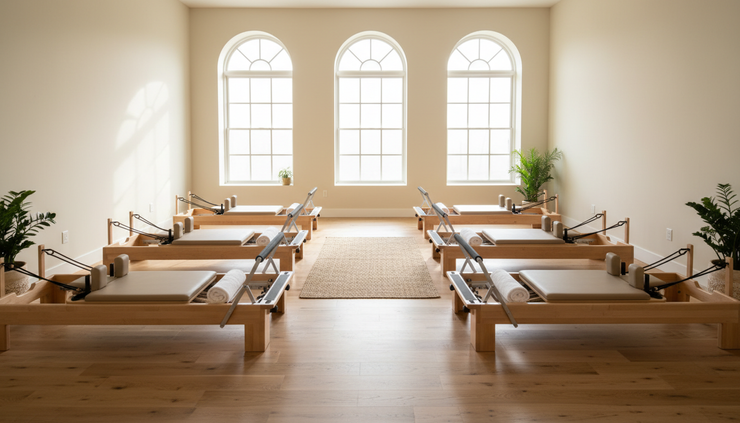
Walking into a Reformer Pilates studio for the first time can feel exciting, but also a little mysterious. The reformer beds look sleek, the springs have different colours, the straps have a purpose you do not yet know, and everyone seems to understand a language that has not been explained yet.
That is exactly why a proper beginner course makes such a difference.
Our 3 week beginners course is designed for total beginners who want to learn Reformer Pilates in a calm, clear, supportive way. Across 2 classes a week for 3 weeks, you get 6 sessions in total for £85, giving you time to build confidence, learn the basics, and understand how the reformer beds work before moving into regular classes.
No rushing. No guessing. No feeling left behind.
This course gives you a strong foundation, so every class after it feels more familiar, safer, and far more enjoyable.
A beginner course removes the guesswork
Reformer Pilates is one of those things that can look more complicated than it feels once it has been explained properly.
At first glance, the reformer bed may look like a piece of gym equipment with too many moving parts. There is a carriage that glides, springs that add or reduce resistance, a footbar, shoulder blocks, straps, pulleys, and headrests. It is normal to wonder where to put your hands, how to lie down, which spring to use, or what all the parts are for.
A beginner course gives space for all of that.
Instead of joining a mixed-level class and trying to copy the person next to you, beginners get taught the equipment step by step. That means learning:
How to get on and off the reformer safely
What the carriage does
How the springs change the feel of an exercise
Where to place your feet and hands
How the straps are used
What the footbar is for
How to control the movement rather than rush it
How to listen to clear Pilates cues
This matters because Reformer Pilates is not about throwing yourself into big movements. It is controlled, focused, and precise. The smaller details make the exercises feel better and work better.
When beginners know how the bed works, they stop feeling like the equipment is in charge. They begin to feel in control.
Why 6 sessions works so well for beginners
One taster class can be useful, but it often ends just as things start to click.
A 3 week course gives beginners time to return, repeat, and improve. That repetition is where confidence grows. The first class might be about understanding the reformer and finding your bearings. By the second or third class, the equipment feels more familiar. By sessions five and six, many beginners start to notice that they can move with more control and follow instructions more easily.
The structure is simple:
Week | What happens |
Week 1 | Get familiar with the reformer bed, key positions, breathing, and safe movement |
Week 2 | Build confidence with basic moves, spring settings, and controlled transitions |
Week 3 | Bring the basics together and prepare for regular Reformer Pilates classes |
The course is long enough to build a foundation, but short enough to feel manageable. Two classes a week keeps the practice fresh, without asking for a huge time commitment.
At £85 for 6 sessions, it is also an accessible way to try Reformer Pilates properly, rather than paying class by class and hoping the basics make sense along the way.
The reformer bed starts to make sense
One of the biggest benefits of a beginner course is learning that the reformer bed is not as intimidating as it looks.
The bed is designed to support the body while adding controlled resistance. The moving carriage glides back and forth along rails. Springs attach to the carriage and create resistance. Straps connect to pulleys, letting the arms or legs work in smooth, guided movement patterns. The foot bar supports exercises where the feet or hands press away.
Once these parts are explained, the reformer becomes far less mysterious.
The springs are often the part that beginners find most surprising. More springs do not always mean “harder”, and fewer springs do not always mean “easier”. The spring setting changes the challenge depending on the exercise.
For example, in some footwork exercises, more spring tension can give helpful support. In core-focused exercises, lighter springs may ask the body to control the carriage more carefully. A beginner course helps explain these differences in plain language, so the settings start to feel logical rather than random.
The aim is not to master everything in one session. The aim is to understand enough to move safely, follow the class, and enjoy learning.
Learning the reformer builds confidence quickly
Confidence does not come from being naturally flexible or strong. It comes from knowing what is happening.
Beginners often relax as soon as they learn the names and functions of the main parts of the reformer. They begin to know where their feet go during footwork. They understand when to use the straps. They learn how to return the carriage smoothly. They start to recognise the difference between a movement that feels challenging and a movement that feels wrong.
That is a big shift.
Instead of looking around the room for reassurance, they can focus on their own body. They can listen to the instructor. They can enjoy the class without worrying that everyone else is miles ahead.
This is one reason total beginners often love a structured course. It makes the studio feel like a place to learn, not a place to prove anything.
The basic moves give you a strong foundation
Every good Reformer Pilates practice starts with the basics.
Some people imagine beginner classes will be too easy, but basic does not mean weak. In Pilates, the basics teach the body how to move with control. They introduce alignment, breathing, stability, and smooth transitions. These skills support everything that comes later.
During the 3 week beginners course, the focus is on learning key movements properly. The exact exercises may vary by class and instructor, but beginners can expect to explore simple, foundational patterns such as:
Footwork on the reformer
Bridging movements
Gentle core exercises
Leg work using the straps
Arm work using the straps
Seated or kneeling control exercises
Stretches supported by the reformer
Safe ways to transition between positions
These moves help beginners understand how Reformer Pilates feels in the body. They also teach useful habits that carry over into regular classes.
Footwork teaches control from the start
Footwork is often one of the first things beginners learn on the reformer. It may look simple, but it teaches a lot.
Lying on the carriage with the feet on the foot bar, the body presses the carriage away and then controls it back in. The movement uses the legs, but it also introduces posture, breathing, and control through the centre of the body.
Beginners learn how foot position changes the feeling of the exercise. Heels, toes, arches, and Pilates V positions can all create a slightly different focus. The instructor can also help with knee alignment, hip position, and the speed of movement.
This is a great example of how Reformer Pilates works. The movement may seem small, but the attention to detail is what makes it valuable.
Straps help the body move smoothly
The straps are another part of the reformer that can feel confusing at first. Once introduced properly, they become one of the most enjoyable parts of class.
Straps can be used for both arms and legs. They guide the limbs through smooth, resisted movement. For beginners, this can help build awareness of where the body is in space.
Legs in straps can feel supportive, especially during controlled circles or gentle lowering and lifting movements. Arm work with straps can help beginners connect the shoulders, back, arms, and core in a steady way.
The goal is not to force big ranges of movement. It is to stay controlled, comfortable, and aware.
Bridging introduces spinal movement
Bridging is another common beginner-friendly movement. It often starts lying down, with the feet placed securely, then lifting the hips and rolling through the spine with control.
This type of movement can help beginners explore how the spine moves segment by segment. It also encourages awareness around the hips, glutes, legs, and centre of the body.
Not every body moves in the same way, and that is completely normal. A beginner course gives space for adjustments and options. The instructor can offer support so each person works at a level that feels right.
Basic does not mean boring
The best beginner classes are clear, steady, and surprisingly satisfying.
There is something rewarding about learning a move properly and feeling it improve over the weeks. A movement that felt awkward in week one can feel smoother by week three. Instructions that sounded unfamiliar at the start begin to make sense. The body starts to understand the rhythm of the reformer.
That progress is often what keeps people coming back.
Beginners do not need to chase advanced exercises to feel the benefits of Reformer Pilates. So much value comes from learning how to move well in the foundational exercises.
The course helps beginners feel safe, supported, and included
Trying something new can bring up all kinds of thoughts.
What if everyone else knows what they are doing? What if the class is too hard? What if the instructor uses words that make no sense? What if the reformer moves too quickly? What if you are not flexible enough?
A well-planned beginner course answers those worries before they grow.
Because everyone is there to learn, the pace feels different from a mixed class. There is more time for explanation. There is space to ask questions. The instructor expects beginners to need guidance, because that is the whole point of the course.
That changes the atmosphere.
No one has to pretend they understand the reformer. No one has to know the names of the moves. No one needs previous Pilates experience. The course starts at the start.
Good instruction makes the experience feel personal
The right instruction can turn a nervous first class into an enjoyable one.
Clear beginner teaching often includes:
Simple explanations before each movement
Demonstrations when needed
Reminders about breathing and pace
Help with spring settings
Options for different comfort levels
Encouragement to work with control, not strain
Gentle corrections to support safe technique
Small cues can make a big difference. An instructor might suggest adjusting foot position, softening the shoulders, slowing the carriage, or taking a smaller range of movement. These details help beginners feel the exercise in the right place and move with more ease.
Reformer Pilates should not feel like a test. It should feel like a guided practice, especially at the beginning.
Beginners learn what to expect in regular classes
A beginner course also prepares people for what comes next.
After 6 sessions, beginners usually have a much clearer idea of how a Reformer Pilates class flows. They recognise common starting positions. They understand how the carriage moves. They know the reformer is adjustable. They have practised getting in and out of straps. They have heard common cues before.
This makes the step into regular classes far less daunting.
Instead of arriving as a complete beginner every time, there is already a base level of knowledge. That can make future classes more enjoyable and productive.
It can support strength, flexibility, posture, and body awareness
Many people come to Reformer Pilates because they want to feel stronger, improve flexibility, support posture, or move with more ease. Pilates training can help with strength, balance, mobility, and body awareness when practised regularly and taught well.
A beginner course is a sensible way to start because it focuses on technique before intensity.
Rather than pushing through movements without understanding them, beginners learn how to control the carriage, use the springs, and connect breath with movement. This can support better movement habits over time.
Results differ from person to person. Fitness level, consistency, injuries, lifestyle, and body type all play a part. Anyone with a medical condition, injury, or concerns about exercise should speak to a qualified health professional before starting.
Still, for many people, Reformer Pilates becomes a steady, enjoyable way to move. The beginner course helps make that first step feel much easier.
What makes our 3 week course such good value
A short, structured course gives beginners something that a single drop-in class often cannot provide: continuity.
Each session builds on the last. You do not have to learn everything in one go. You get time to absorb the basics, repeat key movements, and grow more comfortable with the reformer beds.
For £85, the course includes:
What is included | Why it helps |
6 Reformer Pilates sessions | Enough time to learn, repeat, and improve |
2 classes per week | Regular practice without feeling overwhelming |
A 3 week structure | A clear start and finish point for beginners |
Beginner-focused teaching | The pace suits people new to the reformer |
Equipment guidance | Learn how the reformer bed, springs, straps, and foot bar work |
Basic movement practice | Build confidence before joining regular classes |
This structure makes the course feel approachable. There is no pressure to commit long term before knowing whether Reformer Pilates suits you. At the same time, it gives enough experience to make a fair judgement.
One class can be affected by nerves. Two classes can still feel new. Six sessions give beginners a much better chance to settle in.
It suits people who like to learn properly
Some people are happy jumping straight into a class and picking things up as they go. Others prefer to understand the basics first.
This course is ideal for anyone who likes clear instruction and a gentle learning curve. It suits total beginners who want to know what they are doing, not just follow along and hope for the best.
It can also suit people returning to exercise after a break, as long as the class is appropriate for their body and needs. The focus on technique, support, and gradual learning can make the first step feel less overwhelming.
It gives beginners a routine
Two classes a week for three weeks creates a simple routine.
That matters because confidence often comes from showing up more than once. The first session breaks the ice. The next few sessions build familiarity. By the end, Reformer Pilates can start to feel like something you do, not something you are trying to understand from the outside.
A short course also gives a sense of progress. There is a beginning, a middle, and an end. That can feel motivating, especially for someone new to fitness classes or nervous about group exercise.
The course makes regular classes feel less intimidating
After the beginner course, the reformer no longer feels like a strange piece of equipment.
Beginners have already practised the basic moves. They know where the straps go. They understand that springs change depending on the exercise. They have heard the main cues. They have experienced the pace of a Reformer Pilates class.
That makes moving into regular sessions feel much smoother.
There will still be new exercises to learn, of course. Pilates always offers room to progress. But the foundation is there, and that foundation makes all the difference.
What beginners often notice by the end of the course
By the end of 3 weeks, beginners often feel very different from how they felt at the start.
The reformer becomes familiar. The movements start to make sense. The language of class feels less confusing. The nerves usually settle.
Many people notice practical changes such as:
Feeling more confident getting on and off the reformer
Understanding how the springs affect the exercises
Knowing what to expect from a class
Moving with more control
Feeling more aware of posture and alignment
Recognising basic moves and positions
Feeling ready to continue into regular classes
The biggest change is often mental. Starting something new takes courage. Completing 6 sessions proves that Reformer Pilates is learnable, even for someone who begins with no experience at all.
That sense of achievement matters.
It turns “I have no idea what I’m doing” into “I’m getting the hang of this.”
A strong start makes Pilates more enjoyable
Total beginners do not need to be fit, flexible, coordinated, or confident before starting Reformer Pilates. Those things can develop with time. What helps most at the beginning is good instruction, a welcoming pace, and the chance to practice.
That is why our 3 week beginners course works so well.
Across 6 sessions for £85, beginners learn about the reformer beds, how the springs and straps work, and how to perform the basic moves with more confidence. The course takes away the mystery and replaces it with clear, practical knowledge.
Reformer Pilates becomes less intimidating when someone explains it properly. After a few sessions, the bed feels familiar, the movements feel smoother, and the class becomes something to enjoy rather than worry about.
For anyone curious about Reformer Pilates but unsure where to start, a beginner course is the perfect first step. It gives you the basics, the confidence, and the support to keep going.


Comments